Oral Minoxidil for Women: Benefits, Dosage & Results

Hair shedding, a widening part, reduced ponytail volume, and diffuse thinning can be upsetting. Hair loss also has many possible causes, including female-pattern hair loss, hormonal changes, menopause, stress-related shedding, nutritional issues, medication effects, and certain health conditions.
For some patients, oral minoxidil for women may be a prescription option. It is a daily tablet that a doctor may prescribe at a low dose to support hair growth and reduce shedding, if they determine it is medically appropriate.
A medical evaluation helps identify the likely cause of hair loss before treatment begins. Results are gradual, and continued treatment is usually needed to maintain treatment-related improvements. This guide explains oral minoxidil benefits, dosage considerations, expected results, side effects, topical versus oral treatment, and online prescription care.
If you are seeking a prescription hair loss pill for women, explore The Hair Pill from Musely. A licensed provider reviews your consultation and determines whether treatment is clinically appropriate.
How Oral Minoxidil for Women Promotes Hair Regrowth
What oral minoxidil is
Minoxidil was originally developed as a medication for high blood pressure. Clinicians later observed increased hair growth in some people who took it. Today, low-dose oral minoxidil is sometimes prescribed for hair loss.
Oral minoxidil is taken as a daily pill and works systemically, meaning it circulates through the body rather than being applied directly to the scalp. A licensed clinician should determine whether it fits your health history and hair-loss concerns.
The American Hair Loss Association explains low-dose oral minoxidil as a clinician-directed treatment that requires individualized prescribing.
How it may support the hair-growth cycle
Minoxidil is believed to affect blood vessels and help prolong the anagen phase, which is the active growth phase of the hair cycle. More follicles may remain in, or move into, this growth phase over time.
For some patients, this may lead to less shedding, new hairs, and gradual changes in visible density. Oral minoxidil does not guarantee regrowth, and it does not address every cause of hair loss.
Read Understanding Minoxidil Pills Treatment for Hair Loss for more detail about systemic delivery and how pills differ from scalp treatments.
Hair-loss types a clinician may evaluate
Oral minoxidil is most often considered for androgenetic alopecia, also called female-pattern hair loss. This condition may show up as a widening part, lower density around the crown, or increasingly visible scalp over time.
A clinician may also assess whether oral minoxidil could have a role in chronic telogen effluvium, which involves ongoing shedding. Treatment still depends on the cause. Thyroid conditions, nutritional deficiencies, medication changes, inflammatory scalp conditions, and hormonal shifts may need a different plan.
Sudden, patchy, painful, inflamed, or rapidly progressing hair loss needs medical evaluation rather than self-treatment. Cleveland Clinic’s overview of oral minoxidil for alopecia discusses clinician-directed use across several hair-loss conditions.
Oral Minoxidil Benefits for Women
The potential benefits of oral minoxidil depend on the cause of hair loss, treatment consistency, dose, and individual health factors.
Potential oral minoxidil benefits include:
Less ongoing shedding for some patients
Gradual visible regrowth and improved density over time
Fuller-looking hair around the part line, crown, or throughout the scalp
A once-daily treatment format that may be easier to maintain than a scalp treatment
Systemic delivery that reaches the full scalp without careful application to thinning areas
Why some women consider oral instead of topical minoxidil
Topical minoxidil is an established hair-loss treatment. It is applied directly to the scalp and may suit people who prefer not to take a systemic medication.
Some women find topical foam or solution difficult to use consistently. It can leave residue, interfere with styling routines, or irritate the scalp. A daily pill may fit more easily into a routine for some patients.
Oral minoxidil requires medical screening because it can cause systemic side effects. The right format depends on your diagnosis, health history, preferences, and clinician guidance.
Do not combine oral and topical minoxidil unless your prescriber recommends it. Compare the two approaches in Musely’s guide: Which hair loss treatment should I order? Topical or Oral? or read a dermatologist’s discussion of oral and topical medications.
Who may be a candidate
A clinician may consider oral minoxidil for women with evaluated thinning or shedding who want a prescription option and can take a daily medication as directed.
Before prescribing, a clinician should review:
The pattern and likely cause of hair loss
Current medications and supplements
Blood-pressure, heart, kidney, and liver history
Pregnancy, breastfeeding, or plans to become pregnant
Previous hair-loss treatments
Menopause-related hair changes are a common reason women seek care. Oral minoxidil does not treat menopause itself. A clinician can assess whether it may fit into a broader plan for thinning during this stage of life.
If you are looking for female hair loss treatment online or hair loss due to menopause treatment online, Musely provides a convenient path to professional evaluation. Prescription care, without the waiting room.
The Science Behind Low-Dose Oral Minoxidil for Women
Studies of low-dose oral minoxidil in women with female-pattern hair loss have found stabilization or improvement for many participants. Study designs, dose ranges, follow-up periods, and concurrent treatments vary, so no study can predict an individual outcome.
A retrospective study included 148 women with female-pattern hair loss. Participants used doses ranging from 0.25 mg to 2 mg daily, with a median dose of 1 mg. Many participants also used other hair-loss treatments, so the results cannot always be attributed to oral minoxidil alone. Read the full low-dose oral minoxidil study in women.
A broader review of low-dose oral minoxidil for alopecia describes the varied dose ranges, reported outcomes, and adverse effects across published studies.
What this means for you: Existing research supports a clinician-guided discussion of oral minoxidil. Your provider should assess your response over several months, not days or weeks.
Oral Minoxidil Dosage for Women
Dosage is personalized
There is no one-size-fits-all oral minoxidil dosage for women. Do not start, increase, split, or combine doses based on social media, general articles, or another person’s prescription.
Clinicians generally start with a low dose and may adjust treatment based on response, side effects, and medical history. Doses used for hair loss are lower than historic doses used for blood-pressure treatment. The American Hair Loss Association notes that low-dose regimens vary and need clinician guidance.
How to take oral minoxidil
Take oral minoxidil exactly as prescribed. Take it at a consistent time each day to support adherence.
Follow the instructions on your prescription label. Ask your doctor what to do if you miss a dose. Do not double a dose or make a dose change without medical direction.
Hair-cycle changes occur gradually, so daily consistency matters. Treatment-related improvements may diminish after treatment stops. Musely’s guide to oral minoxidil expectations and safety explains why continued treatment is often needed to maintain results.
Musely oral minoxidil and prescription care
Musely oral minoxidil is part of a clinician-guided hair-loss treatment plan. The Hair Pill formula may vary based on your needs and your provider’s clinical judgment. It is not an over-the-counter product or a medication to self-select.
For current formula information, see What are the formulas of The Hair Pill?
Musely treatments are formulated by U.S. dermatologists and compounded fresh for you. If you are looking for minoxidil for women prescribed online, begin with a consultation. A licensed provider decides whether a prescription and formula fit your needs.
Oral Minoxidil Results Timeline: What to Expect
Hair grows slowly. An oral minoxidil results timeline usually unfolds over months.
Months 1 to 2: Adjustment and possible initial shedding
Some patients experience temporary increased shedding early in treatment as follicles move through the hair cycle. This is possible, but it does not happen for everyone.
Report severe, persistent, or concerning shedding to your prescribing clinician. Do not stop or change your medication without guidance. Musely covers early changes and longer-term expectations in this oral minoxidil hair-regrowth guide.
Months 3 to 6: Early signs of response
Some people first notice less shedding, short new hairs near the hairline or part, or gradual changes in fullness. Others need more time before they see visible change.
Cleveland Clinic notes that some patients may see results around four to six months. Timing varies by the cause of hair loss and individual response.
Months 6 to 12 and beyond: Assessing density and maintenance
A more useful assessment of density and volume often takes 6 to 12 months. Take progress photos using the same lighting, angle, distance, and hair part each time. These photos can help you and your clinician track gradual changes.
Continued treatment is generally needed to maintain improvements supported by minoxidil. If treatment stops, hair may gradually return toward its previous pattern. Learn more in Musely’s oral minoxidil timeline and safety guide.
Oral Minoxidil Side Effects and Safety
Oral minoxidil side effects can occur, and their severity differs from person to person. Because oral minoxidil works throughout the body, medical screening and follow-up matter.
Potential side effects include:
Unwanted facial or body hair growth, called hypertrichosis
Temporary increased shedding early in treatment
Headache
Dizziness
Nausea
Fluid retention or swelling
Changes in heart rate or palpitations
Hypertrichosis is among the more commonly reported effects in low-dose oral minoxidil research. The American Hair Loss Association’s review provides further context on reported adverse effects.
Seek prompt medical guidance for chest pain, fainting, severe dizziness, shortness of breath, rapid heartbeat, sudden swelling, or rapid weight gain.
This list does not replace medical care. Symptoms involving the heart, breathing, or circulation require prompt attention.
Who should discuss oral minoxidil carefully
Oral minoxidil may not be appropriate for everyone. People who are pregnant, trying to conceive, or breastfeeding should discuss alternatives with a clinician. Do not start or continue treatment during these times without medical guidance.
Tell your clinician about heart, kidney, liver, or blood-pressure concerns, past heart-related symptoms, and all medications and supplements. The American Academy of Family Physicians discusses treatment considerations for minoxidil.
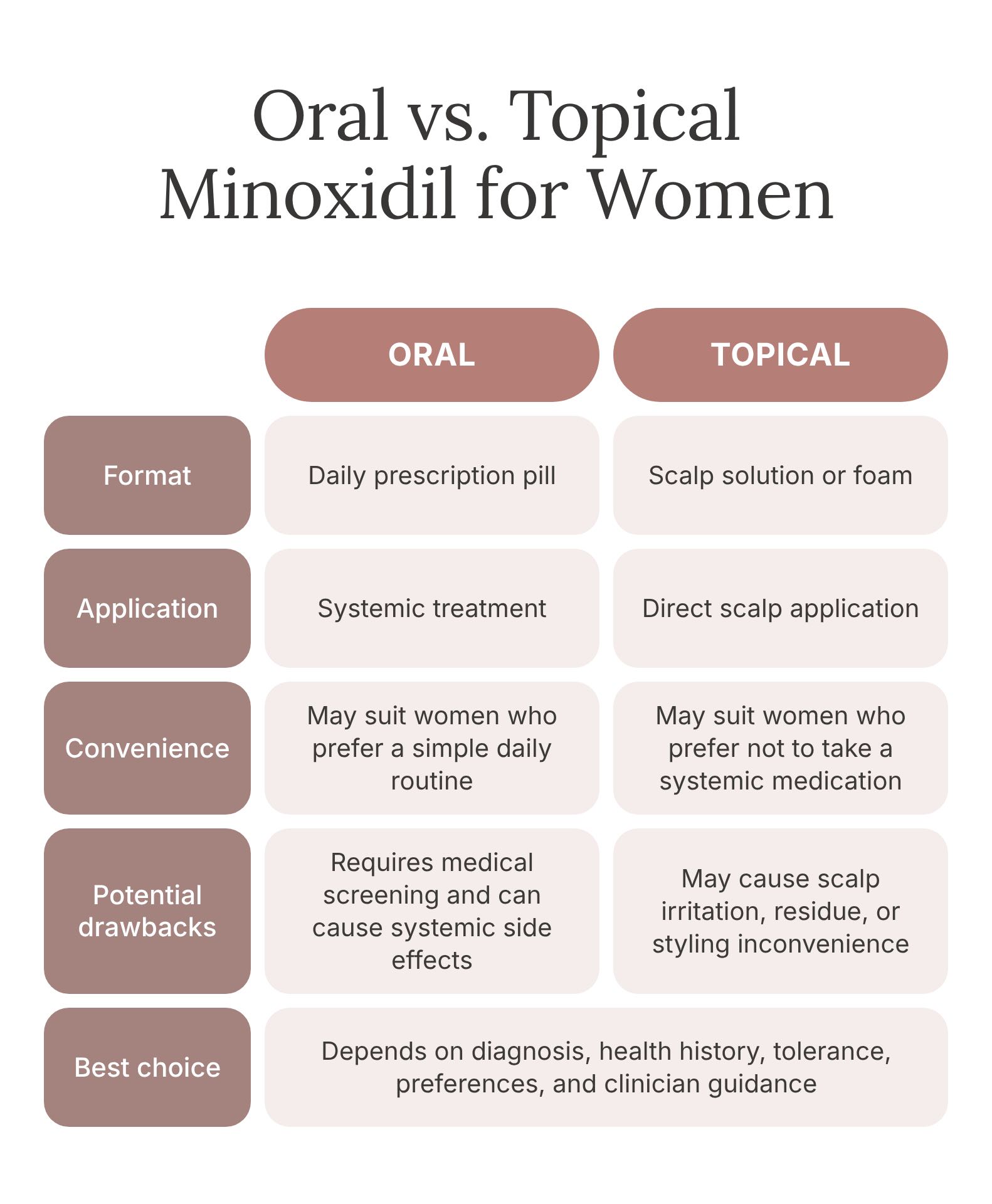
Some clinicians may use oral and topical approaches in selected cases. Combination treatment needs clinician direction because oral minoxidil is systemic and may not be appropriate to combine in every case.
Other therapies may be considered depending on the cause of hair loss. Read Dutasteride vs. Minoxidil: Which Treatment Is Right for You for a clinician-guided discussion of treatment options.
How to Get Oral Minoxidil for Women Online
Online prescription care can make it easier to seek help for thinning, shedding, and hair balding treatment concerns. It should still include medical screening and a licensed clinician’s review.
Musely’s care process has three steps:
Complete an online hair-loss consultation. Share relevant health information, medications, treatment history, and hair concerns.
A licensed provider reviews your submission. The provider determines whether treatment is clinically appropriate.
Receive medication and follow-up guidance if prescribed. Use the online care platform for treatment questions and progress updates.
For readers searching Musely oral minoxidil, female hair loss treatment online, or a prescription option for thinning, The Hair Pill from Musely is a place to start. We’ve treated over 1.4 million patients and counting.
What Real Patients Say About Hair Pills
Patient experiences can help explain what a treatment routine feels like over time. They do not predict your outcome, and individual results vary.
The Hair Pill reviews include patient experiences with convenience, reduced shedding, gradual changes in hair growth, and confidence. Read The Hair Pill oral medication reviews to explore individual experiences.
Reviews are not medical advice. Your results may differ based on your diagnosis, formula, consistency, and health factors.
Common Questions
How does oral minoxidil work for women?
Oral minoxidil is a prescription pill used at low doses to support hair growth. It is believed to influence the hair-growth cycle and follicle environment, which may reduce shedding and support regrowth for some patients. A clinician should review your health history before prescribing it.
What is the best oral minoxidil for women?
There is no universal best oral minoxidil for women. The right treatment and formula depend on the type of hair loss, medical history, pregnancy considerations, other medications, and a clinician’s assessment. A Musely consultation can help determine whether The Hair Pill treatment plan is appropriate.
What is the typical oral minoxidil dosage for women?
Dosing is individualized and often starts low. Only a clinician should make dose changes. In a study of 148 women with female-pattern hair loss, doses ranged from 0.25 mg to 2 mg daily, with a median dose of 1 mg. This study range is not a self-dosing guide. Read the study here.
How long does oral minoxidil take to work?
Some patients notice early changes around 3 to 6 months. Assessing fuller results often takes 6 to 12 months or longer. Consistent use matters, and each person responds differently.
Does oral minoxidil cause shedding at first?
Temporary early shedding can occur as hairs move through the growth cycle. It does not happen for everyone. Contact your provider if shedding feels severe, prolonged, or concerning.
Can women take oral minoxidil during pregnancy or breastfeeding?
People who are pregnant, trying to become pregnant, or breastfeeding should discuss alternatives with a clinician. Do not start or continue oral minoxidil without medical guidance during these times.
Can I use oral and topical minoxidil together?
Treatment combinations should be directed by a clinician. Oral minoxidil is systemic, and combining it with topical minoxidil may not be appropriate in every case.
What happens if I stop taking oral minoxidil?
Hair improvements supported by treatment may gradually diminish after you stop taking oral minoxidil. Musely’s guide to oral minoxidil expectations explains why continued treatment is often needed to maintain results.
Find a Personalized Hair-Loss Treatment Plan
Hair loss has many possible causes, and you do not need to handle treatment decisions alone. Oral minoxidil may be a convenient option for appropriate candidates who want a daily prescription format and clinician guidance.
A medical evaluation considers your hair-loss pattern, health history, medications, and treatment goals. Explore The Hair Pill from Musely to begin an online consultation.
Oral minoxidil for hair loss is an off-label prescription use. Treatment is prescribed only when clinically appropriate. Individual results, timelines, and side effects vary. This article is for general education and does not replace medical advice.
Products In This Tip
More tips like this

Women's Hair Loss
Regrow Your Roots: Online Prescription for Hair Regrowth

Women's Hair Loss
How To Find Your Perfect Hair Treatment Combo (Oral vs. Topical Hair Loss Treatment)

Women's Hair Loss
From Loss to Recovery: A Comprehensive Look at Female Hair Loss and Regrowth Techniques

Women's Hair Loss
Grieving My Hair: The Emotional Toll Of Hair Loss

Women's Hair Loss
Will I Need Lifetime or Temporary Treatment for Hair Loss?

Women's Hair Loss
Thinning Hair? Facts About Female Hair Loss And Hair Loss Treatment For Women!

Women's Hair Loss
Can Women Use Minoxidil? Is It Safe and What Are the Side Effects?

Women's Hair Loss